


Building Habits You Can Keep Without Forcing Yourself
Contents

This post was automatically translated by AI from the Japanese original. Some photos show Japanese text.
One of my favorite sayings is “Things that get results move slowly.”
I feel like I read it in some book, but I’ve forgotten which.
Doing what you want to do, even in a small way, and keeping at it steadily.
I feel like that is what helps me grow.
Today I’ll write about my own tips for making habits stick.
What I’ve managed to keep up
They’re all different kinds of things, but these are the habits I’ve kept going so far.
- Daily exercise
- Duolingo
- Memorizing 10 to 30 words every day
- English Hanon (in Japanese)
- Read for 30 Minutes and Underline: My Simple Extensive Reading Habit
- Writing this blog
- Drawing
- Learning music scales and chords
What made me happiest was being able to turn exercise into a habit!
Until now I kept going through periods of doing it and not doing it, so I never really felt that I was “keeping it up.”
Since last year, though:
- One year of Pilates
- Strength training 2 to 3 times a week
- Stretching almost every day
I’ve kept all of these going for more than half a year. What growth!!
By the way, here’s a book that helped me a lot with building habits.
It doesn’t only explain how to build a system step by step. It also covers the places where people tend to stumble, and it clears up those “what do I do when this happens?” moments, so I recommend it. (The book is in Japanese.)

These three things made it last before I knew it
Do it every day
A habit you do every day is easier to build than one you do 2 or 3 times a week.
When there are no gaps, it’s easier to get back the feeling you have while you’re doing it.
For example, I could never keep up strength training 2 or 3 times a week.
So I changed it to “on days I don’t do strength training, I stretch at home,” and moving my body in some way every day gradually became normal.
Especially until you get used to it, I recommend lowering the bar a little if you have to, so that you “touch it every day.”
It’s also important to adjust it to a level you can do every day.
When I was memorizing 30 English words a day,
the harder the words got, the longer it took to learn 30.
On top of that, lots of words with similar meanings got mixed up, so the load of memorizing became pretty heavy.
So I stopped insisting on 30 a day. I cut it to 15 to 20, or made some days review-only.
Even with a smaller amount, I kept “touching it every day,” so in the end the habit never broke.
Keep a record
- Stamp a calendar
- Put a circle on a Gantt chart
- Stick on a sticker, and so on
I recommend recording what you did that day in a simple way, so you can see it at a glance.
Putting a circle gives you a sense of accomplishment, and you start wanting to keep filling in each day’s blank.
I like analog because it feels like I really did it, and I want to keep it where I can always see it, so I record in a planner that has a habit tracker.
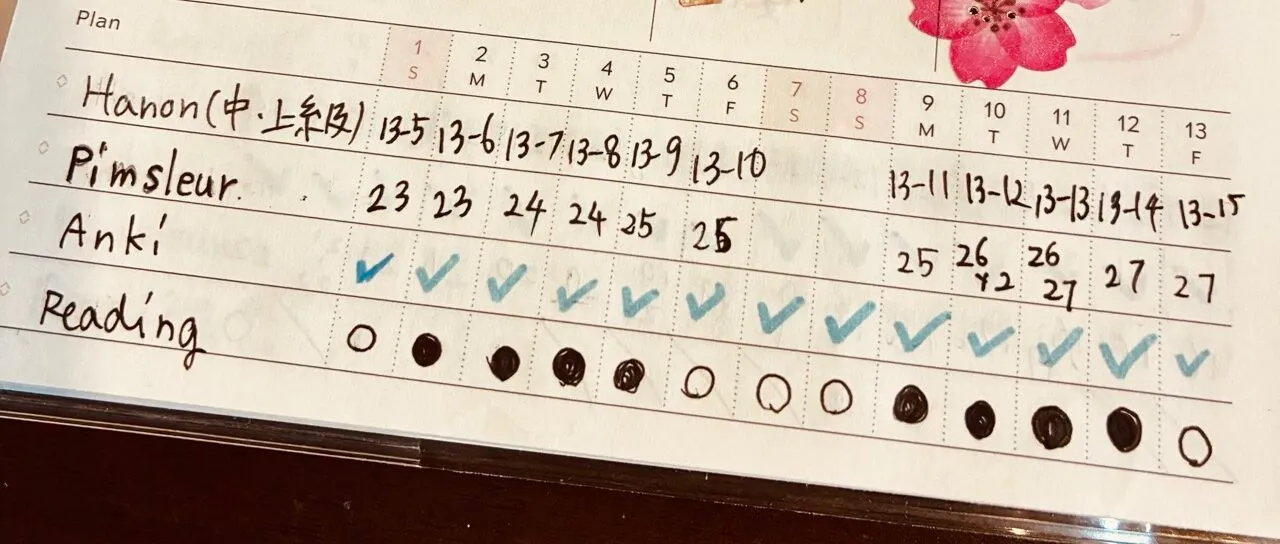
Of course, recording in an app is fine too.
For my reading log, I use an app because it makes it easy to look up books.

My list of English books read extensively
I even made a habit-tracking app you can manage on your phone: A Dream I’d Had for Years Came True in One Week
Add some variety
After about three weeks, “boredom” starts to creep in.
So for exercise, I change the exercises I do, or change what I focus on that day.
On days when I’m motivated I do more, and on days when I’m not, it’s okay to just touch it a little.
For example, when I want to write a new blog post but have no ideas and my hands won’t move, I just tidy up an old post.
I also add exception rules like “it’s fine as long as you touch it in some way,” which beats not doing it at all.
Even within the same genre, I think changing what you do little by little is the trick to keeping at it.
The mindset that makes it a habit
As you keep going, you start to wonder “does this even mean anything?”, or once you take a break you drift away from the habit.
In my case, with exercise, unfamiliar genres take a lot of energy, so I failed to make them stick many times.
This time it has lasted a long while, and the difference is this:
One is finding “fun” and “comfort” in the activity itself.
I don’t actually like moving my body.
But exercise is good for my health.
After I felt that moving and sweating leaves me feeling refreshed, my body learned that it’s a hassle until I start but feels good once I do, so I became able to shut out that “ugh, what a hassle” voice in my head.
I think finding fun in the activity, and feeling that “good feeling” again and again, becomes the driving force for keeping going.
People want to do more of what feels good, after all.
The other is noticing 1 mm of change.
With things like memorizing words or reading books, once you can see what you’ve built up, like “I learned this many” or “I read this many,” you don’t want to waste that effort, so it’s easier to continue.
With words, you’ll find “Oh, I learned this word yesterday!” in a book or a movie.
It’s easy to feel that what you’re doing means something, and that becomes motivation to continue.
On the other hand, things where you can’t feel much change are hard to keep up.
If you build a daily habit aiming only at results, your spirit breaks all at once during the stretch where you can’t see any change.
So, even within the same routine, I think it’s good to catch the change: “today I learned one new thing,” “I tried one new thing.”
If you slack off, just quietly start again today
As I’ve turned all sorts of things into habits, I’ve come to see that doing them 100% perfectly every day is hard.
We’re only human. Some days we get sick, some days we really aren’t in the mood, and some days our schedule fills up and a habit falls through the cracks.
So I make up my mind that it’s okay to stop partway, and that I can just start again.
In the long run, what matters is that you did it on most days overall. If it isn’t zero, you’ve moved forward even by 1 mm.
If there’s something you want to keep doing but haven’t been able to, it’s fine to have days you skip.
The days you did it haven’t disappeared.
You can just quietly start again today.


