


I Made My 2020 Planner in Illustrator

This post was automatically translated by AI from the Japanese original. Some photos show Japanese text.
The new year has begun.
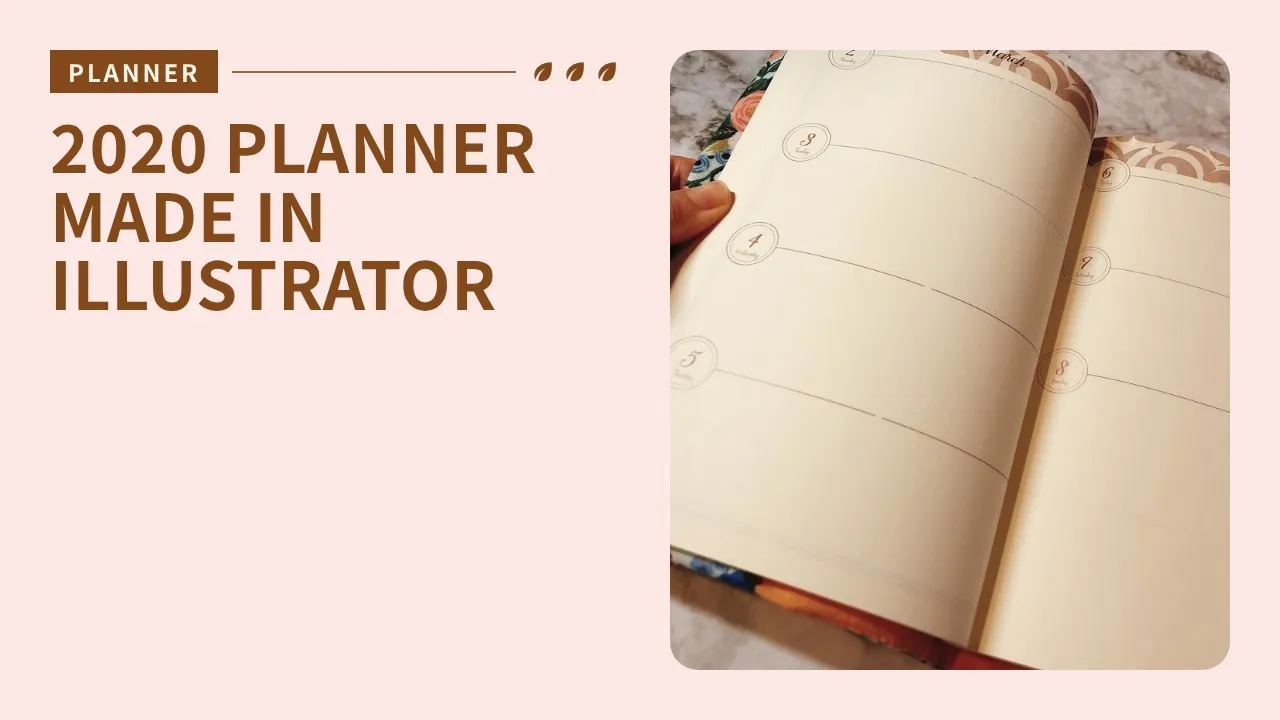
I made my own 2020 planner, my companion for this year.
▼ How to make the calendar in Illustrator
How to Make Your Own Calendar Refills for a Ring Planner in Illustrator (A5) (in Japanese)
Store-bought planners are either too short or too long for me: not enough free pages, or pages I never use. There’s no planner that’s just right. So I thought, why not make one that suits me?
What I write has changed compared to before.
I used to fill my planner with schedules and to-dos, but lately I write more diary entries and how I feel at the time.
Strangely, writing about my feelings gives me a stronger sense of fulfillment. After the year is over, it feels like I can go back to the happiness of those moments: “We had so much fun,” “I was working hard back then.”
YEARLY

At the beginning of the year, I put in a page for writing my wishes for the year, and after the year ends I write the outlook of how I’d like things to be.
There’s also a year story page.
I jot down what I’d like to achieve and what I want to be mindful of in each month. I also look at my horoscope and sometimes write a message like “Is this month a lucky one?”
Like sowing seeds in spring, growing in summer, harvesting in autumn and ripening in winter, I write down the flow of the year.
MONTHLY

Along with the calendar, I’ve included a vision page at the start of each month and a review page at the end.
The vision page is for letting my imagination run and making plans.
I write a forecast of the future: “I hope this month goes like this” and “I hope I’m in this state by the end of the month.”
I also note down messages from my horoscope that catch my eye.
On the review page at the end of each month, I write the month’s memories. “I got to do this,” “I got this nice thing,” and so on. It’s easy to recall later, and I can soak in the happy feeling again.
WEEKLY
In my twenties, I worked hard at not wasting time, and I recorded in my planner what work I’d do in gaps of a few dozen minutes.
But in the past few years, I’ve almost stopped writing a time axis in my planner.

On the left side, I write my schedule and to-dos.
The key is not to write too many.
About three things I want to work on in a day is just right.
On the right side, I write a diary.
“I was so happy that this happened.”
“I feel happy.” I write the good things and the things I managed to do.
When there’s blank space, I stick in photo stickers
so that I can remember what I was doing.
How it turned out
I had it bound at Seihon Chokuso.com (a Japanese service that binds a single copy).


The color has a yellowish tint, giving it an antique feel. I also made a floral planner cover.
I hope it’s a wonderful year.


